

1. The influence of pump pressure and stroke times.
Both pump pressure and pump stroke are important factors that affect piston life. The higher the pump pressure and stroke, the shorter the life of the piston. As the pump pressure increases, the contact pressure between the piston cup and the cylinder liner increases, and the friction force increases rapidly, generating a large amount of friction heat. Under the influence of surface friction heat and internal friction heat, rubber molecules will undergo thermal cracking or thermal cross-linking, which will accelerate the wear, oxidation, aging and hydrolysis of rubber materials, resulting in a decrease in material properties and wear resistance. As the temperature increases, the elastic modulus and tensile strength of the material decrease. After a certain temperature is exceeded, the wear resistance drops sharply and the elasticity is lost. The piston lost its sealing ability and malfunctioned.
As the pump pressure increases, the service life of the piston decreases rapidly. As the number of strokes increases, the service life of the piston becomes shorter and shorter. As the number of strokes increases, the velocity, acceleration, and inertial force of the piston increase, which makes the alternating load on the piston not only increase in value, but also the frequency of the alternating, resulting in additional adverse effects. According to literature reports, under the same working conditions, the piston stroke is increased by 1.3 to 1.5 times, and the service life of the piston is reduced by 5 to 6 times. It can be seen that the pump stroke has a significant impact on the service life of the piston. Piston wear increases as pump pressure and stroke increase.
At the same time, due to the uneven wear of the piston and the non-neutral structure of the structure, the possibility of eccentric wear is greatly increased. Therefore, selecting the appropriate pump pressure and stroke according to the actual situation can better improve the service life of the piston.
2. The influence of frictional heat
The piston is a rubber seal. An important factor affecting the service life of dynamic seals is frictional heat. Frictional heat and its subsidiary effects are the main factors leading to piston failure. The original form of thermal damage was scorching or surface aging of the rubber material. Rubber is a polymer composite material. At high temperatures, its strength decreases due to the decrease in intermolecular attraction. During drilling, the piston is in a high-pressure, high-speed, heavy-duty working environment. Severe friction will increase the temperature of the rubber piston. As the temperature increases, the rubber will age and crack, which makes the moving surface very easy to wear and reduces the service life of the piston.
A secondary effect of thermal damage is surface deformation at the contact of the rubber with the platen. After working in a high temperature working environment for a period of time, the rubber surface will be permanently deformed. The piston cup is restrained by the cylinder liner, steel core and pressure plate. Compared with steel, rubber material has low stiffness and large thermal expansion coefficient. Therefore, when a large amount of frictional heat cannot be eliminated and the rubber is heated, the cup can only expand in the space between the pressure plate and the cylinder liner and in the gap between the steel core and the cylinder liner, so that the pressure plate falls into the cup and is squeezed pressed into the gap.
The expansion of the pump can damage not only itself, but also the rings of the cylinder liner. The increased radial force due to expansion causes the liner to wear faster. To reduce the effect of frictional heat on piston failure, the heat generated by friction acting on the seals is ensured to be expelled from the system. Although frictional heat is the main factor for piston failure, the frictional heat can be effectively reduced through good heat dissipation conditions and cooling systems.
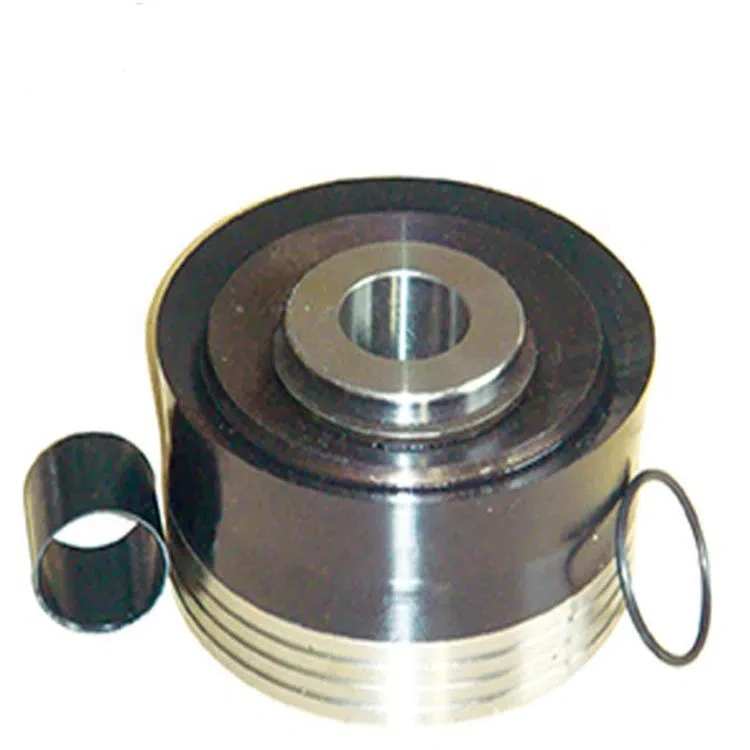
3. Influence of piston clearance
Piston clearance is an important factor leading to piston failure. Piston clearance refers to the gap between the piston steel core and the cylinder liner. During the reciprocating motion of the piston, due to the different axial degrees of the cylinder liner and the steel core and the weight of the piston assembly, there must be wear caused by the direct contact between the cylinder liner and the steel core. This metal is very harmful to metal grinding. Not only does it create huge friction, but it scratches each other easily. This will not only damage the cylinder liner and the steel core, but also the scratched surface will easily damage the piston, easily form perforations and leaks, stop the drilling pump from working normally, and seriously affect the drilling efficiency. The smaller the piston gap, the better the centering effect of the piston steel core, but at the same time, the greater the risk of eccentric wear; the larger the piston gap value, the greater the possibility of the piston cup material flowing to the gap, and the more likely it is crushed. The bigger it is, the more likely it is that the root of the piston will be bitten. Therefore, reasonable clearance value is essential to improve the service life of cylinder liner, steel core and piston.


